

Future Value Calculator – Estimate Investment Growth
Plan your investments with confidence using our free Future Value Calculator. Get instant, accurate results and make better financial decisions.
Future Value Calculator
Always free
Proven logic
Fast results
Responsive
Results
$162,611.89
$70,000.00
$92,611.89
132.30%
Breakdown
Yearly Growth Graph
Yearly Schedule
| Yr | Start | Deposit | Interest | Ending |
|---|
A future value calculator helps you estimate what an initial investment or regular cash flow may be worth at a point in the future. The calculation uses the future value formula, interest rate, investment period, and number of compounding periods to estimate how money can grow over time. This makes it easier to understand the time value of money and compare the value of money today with its potential value in the future.
Whether you are planning long-term savings, retirement, or monthly investments, this tool gives you a clear picture of your future wealth. A FV Calculator is a powerful financial tool that helps you estimate how much your money will grow over time with interest. Whether you are planning long-term savings, retirement, or monthly investments, this tool gives you a clear picture of your future wealth.
A Compound Interest Calculator helps you estimate how much your investment or savings may grow over time using interest rates and compounding. The Investment Returns Calculator helps users estimate investment growth. It shows how savings can grow over time.
By entering your initial investment (initial deposit), interest rate, time period, and regular contributions, you can quickly calculate the future value of your investment and make smarter financial decisions.
How to Calculate Future Value (FV)?
Using our Future Value (FV) Calculator is quick and easy. Enter your starting amount, expected annual interest rate, and the number of years you plan to invest. If you want to add money every month, turn on the monthly contribution option and enter your monthly deposit. Then choose how often your interest is compounded, either monthly or yearly. The calculator will instantly show how your money can grow over time with the power of compound interest.
After entering these details, click the calculate button to instantly see the future value of your investment, including total contributions and interest earned. This tool is very helpful for users searching “how to calculate future value with monthly deposits” or “estimate investment growth over time with compound interest”, as it makes financial planning easy and accurate.
The Future Value Formula
Regular Periodic Contributions (Annuity)
Combined Formula (Initial Deposit + Monthly Contributions)
1. Lump-Sum Formula:
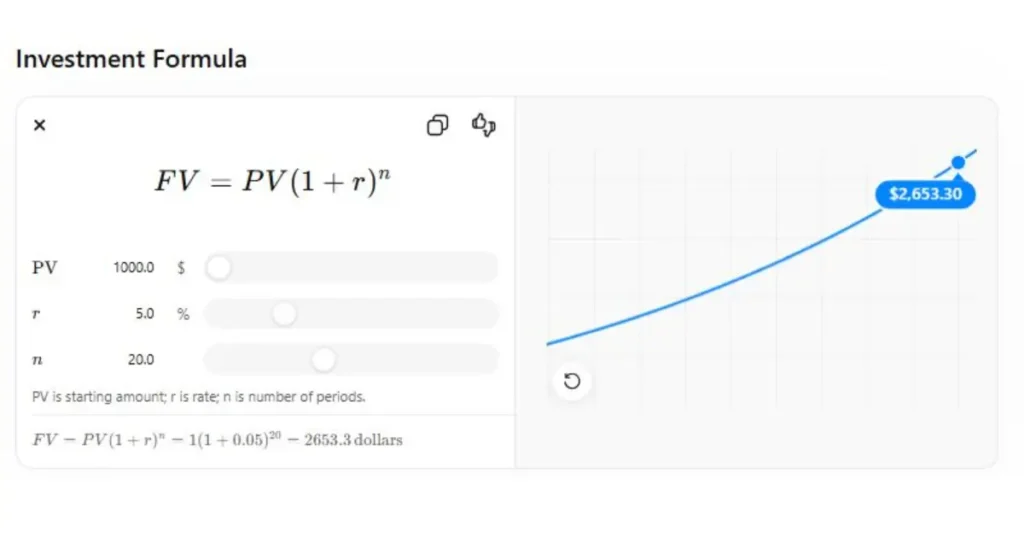
FV = PV × (1 + r)t
2. Combined Formula (Initial Deposit + Monthly Contributions):
FV = PV × (1 + r/n)n·t + PMT × [ ((1 + r/n)n·t – 1) / (r/n) ]
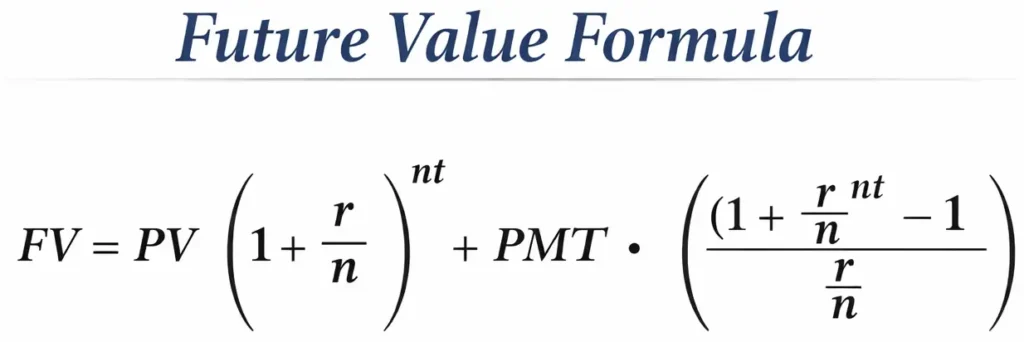
Where:
- FV = Future Value
- PV = Present Value (initial investment)
- r = Annual interest rate
- n = Number of compounding periods per year
- t = Time in years
- PMT = Regular contribution
This formula combines both lump sum investment growth and recurring deposits, making it ideal for real-life financial planning.
What is Future Value and Future Value Calculator?
Future value fv refers to the total worth of an investment at a specific time in the future, based on a given interest rate. It shows how your money grows through compound interest and consistent contributions.
In simple terms, it answers a common question:
👉 “How much will my investment be worth in the future?”
A Future Value Calculator estimates how much your money could grow over time. It uses your starting amount, interest rate, contribution amount, and investment period to show a projected result. Many people use a future value calculator online before making savings or investment decisions.
Think of it as a financial roadmap. Instead of guessing, you can calculate future value and see a realistic estimate of your future investment value. This makes budgeting, investing, and goal setting much easier. It is also called a future savings calculator or future balance calculator.
What information do I need?
You need:
- Initial investment amount
- Interest rate
- Investment period
- Contribution amount (optional)
- Compounding frequency
Future Value vs Compound Interest
Compound Interest is the growth mechanism. Future Value is the final result. In simple terms, compound interest helps create future value.
That is why many people use a future value calculator with compound interest instead of calculating interest manually.
Future Value vs CAGR
CAGR measures the average annual growth rate of an investment. Future Value estimates the ending amount after growth occurs.
How Does a Compound Interest Calculator Work?
An future Home value calculator uses a standard financial formula based on compound interest. It considers:
- Initial investment (present value)
- Interest rate (annual return)
- Investment duration (years or months)
- Compounding frequency (monthly, yearly, etc.)
- Regular contributions (optional)
- rate of return
These inputs help calculate:
- Total future balance
- Interest earned over time
- Contribution vs growth breakdown
- fv of investment
Example Comparison Table
This table helps you understand how small changes can grow your money:
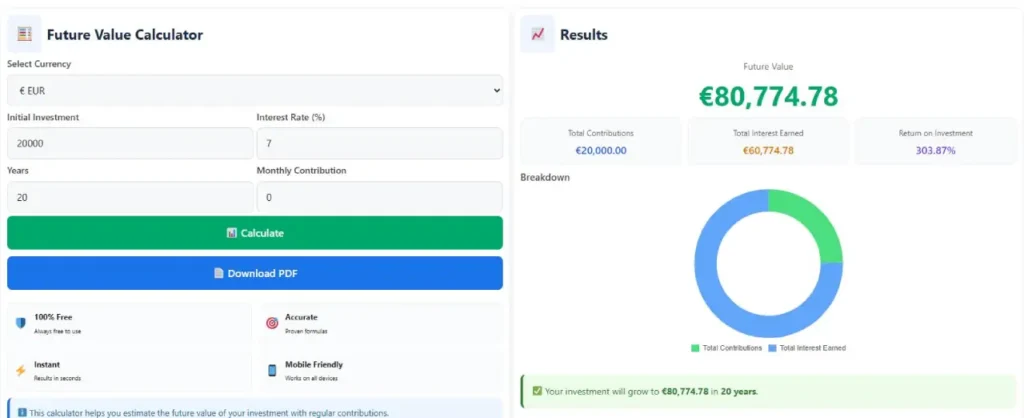
Example: Future Value of a $20,000 Investment
Suppose you invest $20,000 with an expected annual return of 7%, compounded yearly, and you leave the money invested for 20 years without making any additional deposits.
| Investment Details | Value |
|---|---|
| Initial Investment | $20,000 |
| Annual Interest Rate | 7% |
| Investment Period | 20 Years |
| Compounding | Yearly |
| Monthly Contributions | $0 |
Result
After 20 years, your investment could grow to approximately $80,774.78.
- Initial Investment: $20,000
- Total Interest Earned: $60,774.78
- Final Future Value: $80,774.78
| Scenario | Starting Amount | Monthly Investment | Time | Estimated Value |
|---|---|---|---|---|
| Case 1 | $10,000 | $0 | 10 years | $19,671 |
| Case 2 | $10,000 | $200 | 10 years | $54,000+ |
Real Life Example
“If you invest $5,000 at 8% for 10 years, your investment may grow to around $10,794.”
Example 2 — One-Time Investment Growth
Scenario
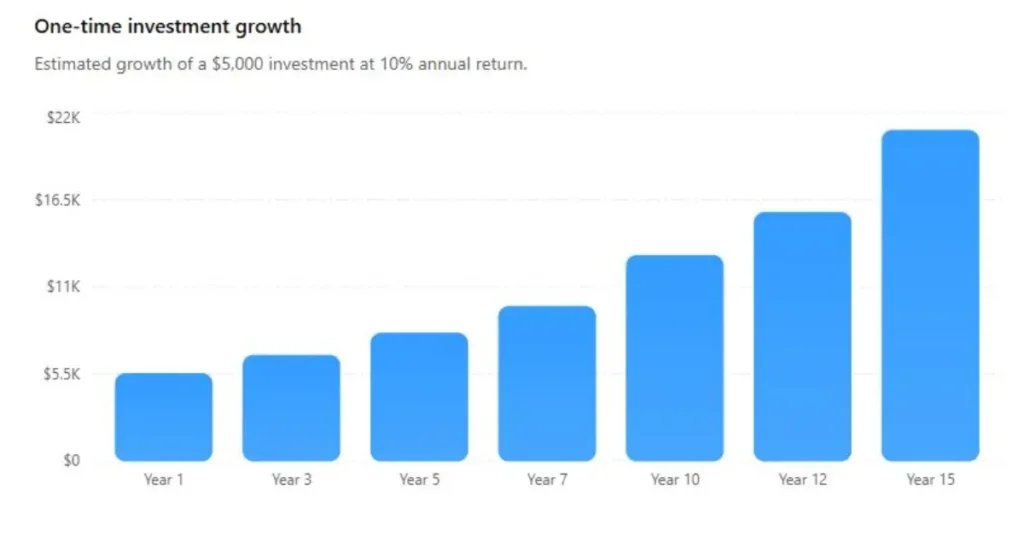
Sara invests $5,000 once and leaves it for 15 years with a 10% annual return.
Result
Her investment may grow to approximately $20,886.
Infographic Points
- Initial Investment = $5,000
- Annual Return = 10%
- Investment Period = 15 Years
- Estimated Value = $20,886
Investment Growth Chart
One-time investment growth
Estimated growth of a $5,000 investment at 10% annual return.
Why Use a FV Calculator?
Using this tool can help you:
- Plan long-term financial goals like retirement
- Estimate investment growth with compound interest
- Compare different savings strategies
- Understand the impact of monthly contributions
- Make smarter investment decisions
It is especially useful for users searching:
- “how to calculate future value of investment with monthly contributions”
- “best compound interest calculator for long-term savings”
- “future value of savings with interest rate and time”
Benefits Of Future Worth Calculator
A Future Investment Calculator is a simple online tool that shows investment growth by adding up compound interest over time, so you can quickly see how today’s money turns into tomorrow’s wealth. It lets people set clear savings goals and test “what-if” scenarios— for example, how to calculate future value of savings with monthly deposits—without doing hard math.
Because the results are visual and instant, it boosts financial confidence, aids in retirement planning for beginners, and helps compare different accounts with just a few clicks.
Using this calculator also teaches key ideas such as present value vs. future value, making it a handy partner for anyone asking “online Investment Growth Calculator for for retirement planning” or “best way to estimate compounded returns over 10 years.”
Why Future Value Matters in Financial Planning?
Understanding future value is the foundation of smart financial planning. Whether your goal is preparing for retirement, buying a home, or funding a child’s education, knowing how today’s savings translate into tomorrow’s wealth helps you invest with confidence.
Even small monthly contributions can grow exponentially over time, transforming steady habits into long-term financial security.
Example: How Your Investment Grows
Let’s say:
- You invest $10,000
- Interest rate is 7% annually
- Time period is 10 years
- Monthly contribution is $200
The calculator will show:
- Future value: $54713.58
- Total contributions:$34,000
- Total interest earned: $20,713.58
This helps you clearly see how small regular investments can grow into large savings over time.
Types of Future Value Calculations
1. Lump Sum Investment
Calculates growth of a one-time investment over time.
2. Recurring Investment (Annuity)
Includes monthly or yearly deposits for long-term growth.
3. Compound Interest Growth
Shows how interest earned also generates additional returns.
Benefits of Compound Interest
Compound interest is the key factor behind future value. It allows your investment to grow exponentially because:
- You earn interest on your initial amount
- You also earn interest on previous interest
👉 This is why starting early can significantly increase your returns.
Who Should Use This Calculator?
Increase your monthly contribution by $50 and compare results
This tool is ideal for:
- Investors planning long-term wealth
- Students learning financial concepts
- Individuals saving for retirement
- Anyone comparing investment strategies
It answers popular queries like:
- “Lump Sum & Recurring Investment Calculator with monthly deposits”
- “how much will my savings grow in 20 years”
- “compound interest calculator with contributions”
Important Factors That Affect Future Value
- Interest rate changes
- Investment duration
- Frequency of compounding
- Consistency of contribution
Even small changes in these factors can significantly impact your final amount.
Pro Tips to Maximize Your Investment Growth
- Start investing early
- Increase contributions gradually
- Choose higher compounding frequency
- Stay consistent with deposits
- Reinvest your returns
- fv of investment
Understanding the Time Value of Money
The time value of money means that money available today can be more valuable than the same amount received at a point in the future because money can potentially earn interest or investment returns over time. For example, $1,000 invested today may grow to a larger amount after several years.
Present value (PV) represents the value of money today, while future value represents what that money may be worth at a future point. The calculation can also include cash flow, such as regular monthly or yearly contributions to an investment. Understanding this relationship helps you see how an initial investment can change over time through interest and compounding.
How Compounding Periods Affect Future Value
Compounding periods determine how often interest is added to an investment balance. Depending on the account, interest may compound annually, semi-annually, quarterly, monthly, or daily. More frequent compounding can affect the final future value because previously earned interest can also begin earning interest.
When using a future value calculator, the number of compounding periods should match the interest rate and investment timeframe. For example, a monthly compounding schedule uses more compounding periods than an annual schedule over the same number of years.
How Inflation Affects Future Value and Purchasing Power
A future value calculation shows how much your money may grow over time based on an expected return. However, it does not always show how inflation can affect your money’s buying power. The inflation rate shows how much the prices of goods and services increase over time.
For example, you may invest $10,000 today and it may grow to $15,000 in the future. But because prices can rise, that $15,000 may not buy as much as it would today. This means that the value of your money can increase while its purchasing power decreases.
That is why it is helpful to consider both investment growth and inflation. Looking at inflation can help you understand what your money today may be worth at a point in the future and how much you may actually be able to buy with it.
Real-Life Use Cases
A future value calculator helps you plan important life goals. You can use it for retirement planning by checking how much you need to save every month for a comfortable future. Also use it for a child’s education fund to see how your savings will grow and cover future school or college costs.
You can use this calculator to plan for buying a house by saving for a down payment. If you want to build passive income, it shows how your regular investments can grow over time. These examples help you see how small savings today can turn into big money in the future.
Pros and Cons of FV Calculator
Pros
- Easy to use for beginners
- Saves time and avoids manual calculations
- Helps in planning long-term goals
- Shows clear investment growth
Cons
- Results are only estimates
- Market returns can change
- Does not guarantee profits
- Does not include all real-life risks
Common Mistakes to Avoid
Many people make small mistakes while using this calculator:
- Ignoring inflation
- Using very high or unrealistic interest rates
- Not adding regular contributions
- Stopping investments too early
- Not checking different scenarios
👉 Avoiding these mistakes gives you better and more realistic results.
Inflation-Adjusted Future Value
Inflation reduces the real value of your money over time.
Simple Formula:
Real Value = Future Value ÷ (1 + inflation rate)^years
Easy Example:
If your future value is $50,000 and inflation is 3% for 10 years,
your real value will be lower than $50,000.
👉 This helps you understand the true buying power of your money.
Call to Action (CTA)
👉 Try different values in the calculator and see how your money grows.
👉 Increase your monthly investment by $50 and compare results instantly.
👉 Start planning today to build a strong financial future.
The Rule of 72: How Fast Will Your Money Double?
The Rule of 72 is a quick, shortcut formula investors use to estimate how many years it takes for an investment to double in value through compound growth.
Example: At an 8% average annual return:
- Example: At an 8% average annual return:$$72 \div 8 = 9 \text{ years to double your investment}$$
What Drives Your Future Value Growth?
While the Rule of 72 gives you a quick snapshot, your actual total growth depends on a few critical factors:
- Expected Return & Growth Rate: Higher yields accelerate compounding, but higher returns usually reflect asset class (e.g., index funds vs. bonds).
- Time Horizon: The longer your money compounds, the steeper the growth curve becomes.
- Regular Contributions: Adding recurring monthly deposits powers wealth creation much faster than initial lump sums alone.
- Compounding Frequency: Whether interest is calculated monthly, quarterly, or annually subtly shifts your effective yield.
- Inflation & Purchasing Power: High inflation reduces real returns, meaning your doubled dollars buy less in the future.
- Risk Tolerance: Your comfort level dictates your strategy, balancing steady growth with market volatility.
Pro Tips to Grow Your Money Faster
- Start investing as early as possible
- Invest regularly every month
- Increase your contributions over time
- Choose better interest rates wisely
- Reinvest your earnings
👉 Consistency is the key to long-term wealth.
Future Value vs Present Value
Many people confuse Future Value (FV) and Present Value (PV), but they represent two different financial concepts.
| Feature | Future Value (FV) | Present Value (PV) |
|---|---|---|
| Meaning | The value of money at a future date after earning interest. | The current value of money that will be received in the future. |
| Purpose | To estimate how much an investment will grow. | To determine how much future money is worth today. |
| Formula Basis | Compound interest. | Discounting future cash flows. |
| Used For | Retirement planning, investment growth, savings goals. | Business valuation, loans, investment analysis. |
| Time Direction | Moves money forward in time. | Moves money backward in time. |
| Main Question | “How much will my money be worth?” | “How much should I invest today?” |
Real-Life Applications
Use Future Value When:
- Planning for retirement.
- Estimating investment growth.
- Calculating savings goals.
- Forecasting college funds.
Use Present Value When:
- Evaluating investments.
- Calculating loan values.
- Pricing bonds.
- Determining how much to invest today.
Simple Example
Imagine someone offers you:
- $10,000 today, or
- $10,000 after 10 years.
Because of inflation and investment opportunities, $10,000 today is worth more than $10,000 in the future. This concept is known as the time value of money, and it is the foundation of both Present Value and Future Value calculations.
FAQs
Q1. What is a Future Value Calculator?
A Future Value Calculator estimates how much your money can grow over time using interest, investment period, and regular contributions.
Q2. How do you calculate future value?
Enter your starting amount, interest rate, investment period, and compounding frequency. The calculator instantly shows your estimated future value.
Q3. What is the future value formula?
The future value formula calculates how much an investment will grow after earning compound interest over a specific time.
Q4. Is compound interest important for future value?
Yes. Compound interest helps your money grow faster because you earn interest on both your savings and previous interest.
Q5. Can I use this calculator for retirement planning?
Yes. It helps estimate how much your retirement savings could grow based on your investment assumptions.
Q6. Does inflation affect future value?
Yes. Inflation reduces the purchasing power of your money, so your future savings may be worth less in real terms.
Q7. How accurate is a Future Value Calculator?
The calculator provides accurate estimates based on the information you enter. Actual investment returns may vary because market performance can change.
Q8. What is a good annual interest rate for long-term investments?
Many people use 5% to 8% as a long-term estimate, but the right rate depends on your investment type and market conditions.
Q9. How much will $100,000 be worth in 30 years?
The result depends on your interest rate. At a 7% annual return, $100,000 could grow to about $761,000 in 30 years.
Q10. Is this Future Value Calculator free to use?
Yes. You can use our Future Value Calculator online for free without creating an account or paying any fees.
Final Thoughts
A Future Worth Calculator or Compound Interest Calculator is an essential tool for anyone looking to grow their money wisely. You can also called a Retirement planning calculator. It simplifies complex financial calculations and provides clear insights into your investment journey.
By understanding how your money grows over time, you can make better decisions and achieve your financial goals faster.
Other important financial calculators
We provide free online calculators with easy explanations. Every calculator is tested using standard formulas and updated regularly to improve accuracy.
You can also use our best and free calculator tools like, Calculate loan repayments with our
Finance: [Loan EMI Calculator], [401k Calculator], [SIP Calculator], [Hourly to Salary Calculator], [Future Property value calculator],
Construction & Home: [Construction Calculator], [Concrete Calculator], [Limestone Calculator], [Pool Salt Calculator], [Pine Straw Calculator]
Business & Marketing: [CPC,CPM & CTR Calculator]
Fitness & Health: [ Bench Press Calculator], [Peptide calculator], [ Losertown calorie calculator]
Other Useful Tools: [Gematria Calculator], [Grading Bell Curve Calculator], [20 weeks from Today], BMI Calculator
You can also Check our latest articles in our [Blogs] section for more information.
what is Compound Interest Calculator and How to Use a Future Value Calculator?
Read our Privacy policy, terms and conditions, Disclaimer, Cookies, Contact US and about us